

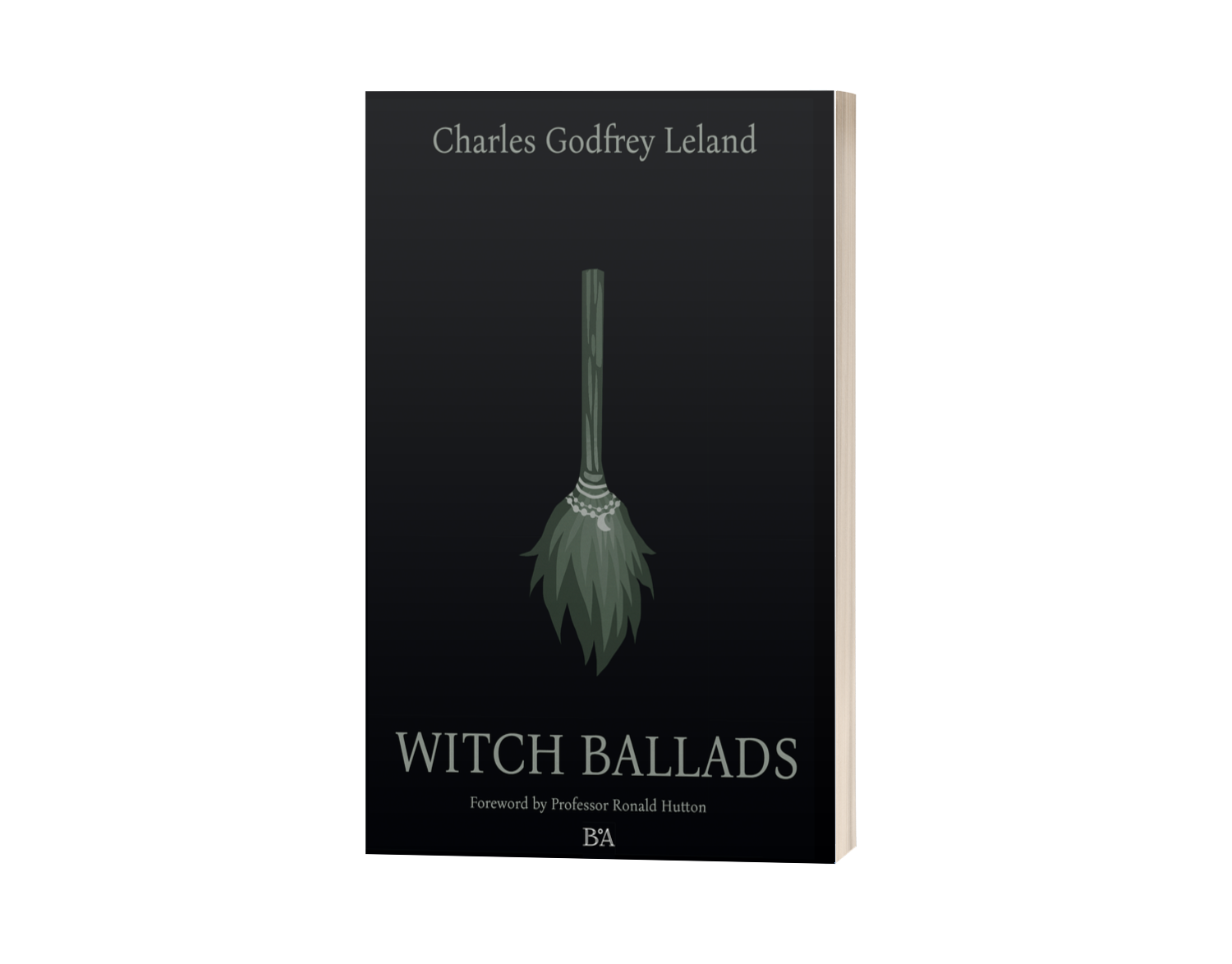
Witch Ballads
Charles Godfrey Leland
Foreword by Professor Ronald Hutton
ISBN 978-0-9933910-9-5
Trade paperback
80 pages
148 x 210 mm
Book design by Pola Szarek-Ratkowska
Illustrations by Agnieszka Wałek
In recent years, more of Leland’s writings, preserved in manuscript in Philadelphia, have been brought into publication, including a handbook of early modern magic, collected by him from various sources and presented as the grimoire of a Yorkshire cunning woman from that period. Now Velkan and Enenna are to be thanked and congratulated for providing us with Leland’s poetry about witches, which exemplifies, in the most delightful and entertaining form, three of his enduring preoccupations. The first is his swashbuckling political liberalism, which made him love witchcraft as an expression of personal freedom, and a sensational escape-route not merely from the forces of repression but from those of conformity and tedium. His witches are those of the mythology that lay behind the early modern trials, flying off on broomsticks and other enchanted objects to gather and revel at sabbats. The sabbats themselves are hardly described, however, and if Satan or Lucifer is there at all, he is firmly offstage and no acts of evil seem to be planned. Instead the emphasis is always on the journey, the break with normality, conformity and obedience. His second preoccupation is his passion for and delight in the natural world, for its beauties and wonders, with which to him witchcraft is intrinsically linked. The third one is with women, whom he always viewed with reverence and affection as beings entirely different from men, alluring, mysterious and naturally magical. In real life he sought equality between the sexes, although he disliked some feminists for their disparagement of masculinity. Leland himself never seems to go to the sabbat: when he comes closest to speaking in his own voice he describes the rescue of a witch from the sabbat and from a devilish allegiance, and his taking of her to church. This episode, however, is overwhelmed by the number of poems that celebrate the joys of making the journey successfully, and so knowing a wild joy and a magical empowerment which he himself seems able only to imagine. The enchantment of the verse is all the greater for this yearning, and we can thank both Leland himself, and Bibliotheca Alexandrina, for gifting it to us.
Professor Ronald Hutton,
author of Triumph of the Moon and Witch